Nettle Fabrics
Allo nettle fabrics from Nepal
The nettle fibre, from a plant that endures all our attempts at eradication with infinite patience, was once widespread but has now almost completely fallen into oblivion. Only its name survives - wrongly applied to plain, undyed cotton cloth ("Nessel?).
Entire monasteries in the Middle Ages were dedicated to its production.
In Germany, during the 1930s and 40s, great efforts were made to make nettle fibres usable again as a textile material, though these came to an end with the war. In Hungary, nettle fabrics were even used to store certain types of grain.
Yet it still wanders through our fairy tales as a powerful enchantress (The Seven Swans), where it has the strength to break the spell cast upon the brothers transformed into swans.
Rudolf Steiner, too, attributed special powers to the plant: in his book "The Agriculture Course" he wrote of its potent protective effect against harmful energies and radiation, recommending the fibre especially for children.
What are nettle fabrics?
Today, nettle fibre is still obtained in Nepal. The native Girardinia diversifolia grows to more than three metres in height. It is harvested and peeled by hand, after which the fibre-rich bast is left overnight in a simmering bath of wood ash, which is later used to fertilise the fields. The next morning, the released fibres are beaten on stones and rubbed with clay to remove the last bits of bark. The yarns are then spun by hand and woven into fabric on simple handlooms.
What makes nettle fabrics special?
Like everything in nature, these fabrics have no uniform colour tone: the shades vary from straw to grey-brown or even dark brown, giving the finished piece a beautifully lively marbling. The individual signature of each spinner and weaver makes every item a unique piece.
Fabric in its most original form.
What can nettle fabrics be used for?
Allo fabrics are excellent for artistic work, decorative ideas, upholstery and coverings for furniture, cupboard doors or folding screens - particularly attractive when combined with oak wood - as well as for garments with a primeval character and, of course, authentic costumes from the Stone Age through to the Middle Ages.
The material retains and protects body warmth, is boil-proof, and - like many plant fibres - becomes more beautiful and softer the more it is used.
Availability of our nettle fabrics
Since the fabrics must be gathered by the mountain peoples of Nepal, they are not always available in unlimited supply.
 +49 641 962820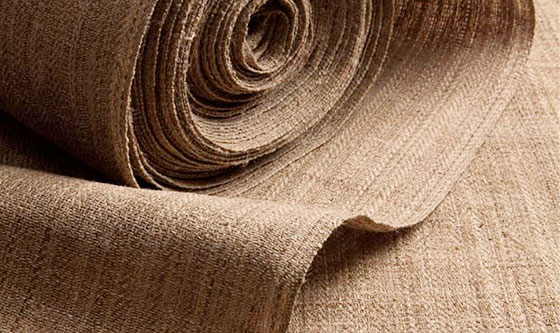
 only limited stock available !
 Available now!