Interesting facts about cotton fabrics - Content:
1. Properties of cotton and cotton fabrics
Cotton fabrics have the highest market share of all natural fibre fabrics and their fibres are still the most important naturally grown textile raw material in the world!
The quality of the cotton depends on the fibre length, which can be spun finer the longer it is. The best cotton with a staple length of over 32 mm - ‘Gossypium barbadense’ - comes from Peru and is known there as Pima cotton. In Egypt, it is cultivated and traded as Maca cotton.
Cotton is incredibly versatile and can be used for technical and medical fabrics, for wadding and nonwovens, for decoration, interior design and linen and ubiquitously as a clothing textile.
Cotton fabrics are unproblematic, versatile and inexpensive. The natural cotton fibre does not cause allergies, is boil-proof and therefore hygienic. It does not become electrostatically charged. Cotton fabrics are breathable, durable, absorbent and comfortable to wear.
Their disadvantages include creasing, mould staining when stored in damp conditions and relatively easy flammability. Cotton fabrics can be lightly coated, dyed, roughened or finished in such a way that they neither shrink nor crease and are therefore non-iron or mercerised, in which case they shine like silk.
As a purely plant-based product, cotton fabrics are vegan textiles made from natural fibres.
2. What types of cotton fabrics exist?
The generic term ‘cotton fabrics’ is used here for all types of fabric that are made entirely or largely from cotton fibres.
A basic distinction is made between the two types ‘knitted fabric’ and ‘woven fabric’:
2.1 Knitted fabrics are knitted or finest knitted fabrics made of cotton
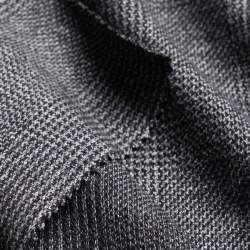
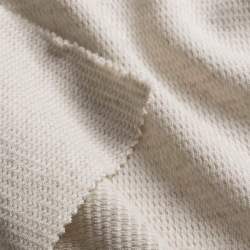
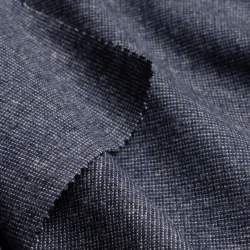
Knitted fabrics are produced on knitting machines. They are naturally stretchy and therefore particularly comfortable. Fine knit fabrics (jerseys) are often used for body-hugging clothing such as underwear, T-shirts, dresses and leggings, as they adapt to every movement.
The combination of purl and knit stitches creates a wide variety of jerseys or knitted fabrics.
Single jerseys consist of a simple knitted fabric with knit stitches at the front and purl stitches at the back. They are light, inexpensive and simple, but often have a bias. A cotton single jersey with S and Z yarn twisted in opposite directions is more expensive and has no bias.
Interlock jersey provide more volume, have a right stitch pattern on both sides and are more durable and dimensionally stable.
Bündchen oder Ribs are usually a combination of knit and purl stitches, often 2:2, but 1:1 or other ratios are also possible. Their great stretch makes them particularly attractive for cuffs, tight skirts and fitted garments.
Knitted fabrics also include sweat, polo, nicky, etc.
2.2 Woven cotton fabrics
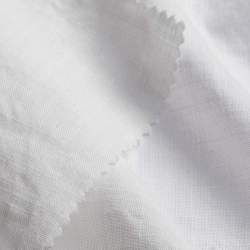
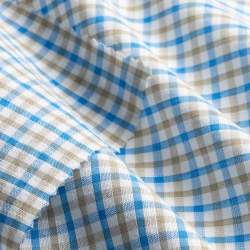
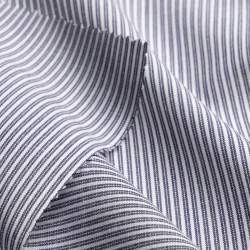
Fabrics are woven by crossing warp = lengthwise and weft = crosswise threads on a loom in different weaves (type of crossing). Without elastane, they normally have no stretch. The following main weave types exist: plain weave, twill weave and satin weave. Almost all cotton fabrics are made from these three basic weaves.
The almost unbelievable variety of woven cotton fabrics is the result of the following factors:
a. Type of yarn: This determines the feel, the twist intensity and structure or thickness of the yarn leads to different fabric structures, determines the drape of the fabric and the thickness of the yarn determines the fabric weight. The fineness of the fibre and yarn determines the quality of the material.
b. Setting the thread density: This can create loose gauze with high transparency or down-proof opacity with all variants in between.
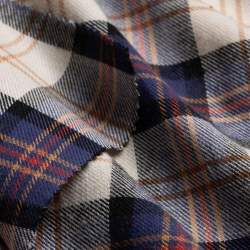
c. Weave type: The weave of warp and weft threads gives fabrics different surfaces. The diagonal twill weave is well-known for jeans, while a shiny, smooth right side is created with a satin weave. There are many different types of weave, ranging from complex woven jacquard or damask weaves.
d. Equipment: This includes all further work steps after weaving/knitting the yarns, e.g. dyeing, printing, mechanical and chemical finishing or processes to give the fabric its character.
3. Cotton fabrics for everyday use
3.1 Shrinkage of cotton fabrics
Many cotton fabrics shrink primarily in the lengthwise direction when first washed and should therefore be washed and then ironed before cutting and processing in order to enable perfect sewing.
The ‘residual shrinkage’ or ‘shrinkage value’ depends on the type of material and the finishing (processing steps after weaving). A raw fabric has a significantly higher shrinkage than a pre-washed or dyed fabric. The shrinkage can be minimised by additional finishing processes such as ‘sanforisation’.
The residual amount of our fabrics is shown on the respective detail page and must be taken into account when calculating the fabric requirement.
It is important to note that shrinkage values are always approximate, as they depend on individual factors such as water hardness, washing machine, detergent and the like.
3.2 Sewing cotton fabrics
Cotton fabrics are easy to work with, but the needle size should be adapted to the fabric, i.e. fine and light fabrics should be sewn with a finer needle size 70-80 and thicker fabrics with a thicker needle size 80-90.
The stitch length should also be appropriate for the type of fabric. Fine, dense and light fabrics should be sewn with a short stitch and open or heavily woven fabrics with a rather long stitch.
Cotton fabrics must be serged at the open edges, which is best done with a zig-zag or overlock stitch to prevent fraying of the edges.
All knitted fabrics should always be sewn with a jersey needle and all seams and hems must be stretchy, which is why it is advisable to use a zig-zag or overlock stitch. A low topstitching foot pressure prevents wavy seams.
3.3. Care-instructions for cotton fabrics
Natural white or bleached pure cotton is generally boil-proof, but only firm, dense cotton fabrics and those for food, hygiene or medical use should be washed at 60-95°C.
As soon as the fabrics are dyed or printed, the washing temperature is usually lowered to 40°C. Very fine-threaded and open-woven cotton fabrics should be washed on a delicate cycle with mild detergent.
The following applies to washing and drying temperatures: the higher the temperature, the greater the shrinkage.
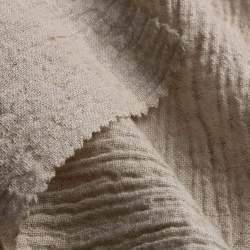
Open weave fabrics shrink more than tightly woven fabrics, and a crepe effect can also be achieved.
Knitted cotton fabrics such as fine jerseys or coarse knitted fabrics should also be washed on a gentle cycle and only spun a little. After washing, pull into shape and dry flat, as knitted fabrics can warp when hung up. This is particularly important to bear in mind when pre-washing, as hanging can cause the fabrics to stretch out at the expense of length. Knitted fabrics can be stretched in both directions.
For blended fabrics, it is advisable to use the more delicate material, for example treating a silk-cotton blend like silk.
Care should be taken when washing any type of coated cotton fabric and treatment according to instructions is recommended.
Pure uncoated cotton fabrics can be tumble dried and ironed on the highest setting. For mixed fibres, the temperature must be adjusted to the more sensitive fibre.
4. Purchasing the right cotton fabric
Whether solid cotton twill for trousers or home textiles, blouse batiste or organic cotton fabric, our shop offers a wide variety for sewing with cotton. (You can find more information on fabric types in our FAQ on the keyword ‘Types of Fabric’)
It is important to us to be able to offer you fabrics made from natural fibres that are grown as ecologically as possible and do not require any additional synthetic finishes. Thanks to their high quality, they have what it takes to become favourite pieces, their long service life makes them sustainable and, in certified GOTS quality, they contribute to the responsible use of resources through the social working conditions of all those involved.
Buying fabrics online can be a real challenge, so take advantage of the opportunity to sample our cotton fabrics before processing them to check the original quality and colour.
You can find more information about our sample service [ HERE ].
Our collection is divided into knitted and woven fabrics, as well as natural and coloured fabrics and organic cotton fabrics.
4.1. Which cotton fabric for which project?
If you want to use cotton fabrics, ask yourself the following questions before buying:
- Does my project require a knitted (jersey) cotton fabric or a non-elastic fabric?
- Do I need a firm or rather light material? These questions can often be answered by looking at the fabric recommendations in the pattern.
- How important are price and sustainability to me? Are you more interested in cost-effectiveness, is the price/performance ratio decisive for you, do you want to buy organic cotton?
- GOTS-certified cotton fabrics are certainly the comparatively best choice, but a regionally produced fabric without certification but without long transport routes can also make ecological sense.
- Do I like a coloured or printed fabric that is washable up to 40° C or should the material be washable at 60° C or higher?
4.2. How much fabric does my project need?
The available fabric width plays a decisive role in calculating the amount of fabric required. You can obtain cotton fabrics from us from 35 cm wide tubular fabrics (ribbed jersey) to oversized widths of over 250 cm.
Either use the fabric consumption indicated in the pattern as a guide, ask a tailor or arrange your pattern pieces between two parallel folding rules or similar at a distance equal to the fabric width of your desired fabric to determine your requirements.
4.3. Our filter search will help you with your selection
On our site 'Themes', you have the option of displaying fabric suggestions for your application. Whether for clothing or home textiles - simply select the desired use and let yourself be inspired!
Have fun at out site [ Themes ]
5. Sustainability of cotton fabrics
Cotton is first and foremost a natural and renewable raw material that can be returned to the biological cycle after use through decomposition. For this reason, cotton fabrics as such are a sustainable textile product.
However, the process from seed to textile end product is often anything but ecological.
As the most common natural fibre, cotton is an integral part of everyday life. It is one of the most important export products for many countries.
You should consider three criteria when deciding which cotton fabrics to buy:
- If possible, buy cotton fabric from organic farming (organic cotton), preferably GOTS-certified.
- Opt for good and durable quality.
- If possible, favour natural or bleached fabrics over dyed ones.
5.1 Conventional cotton fabrics in our range of products
Although the proportion of organic cotton fabrics in our range is constantly being expanded, we have also deliberately opted for a range of conventional cotton fabrics, as we want to offer the greatest possible variety of cotton fabrics and, for example, very good and upmarket qualities, such as our designer fabrics, are not available in organic quality.
We are also happy to support smaller and regional producers for whom certification is unprofitable. Many of our conventional cotton fabrics are produced regionally or left in their natural state. Even without organic certification, we believe they are no less sustainable than a chemically dyed organic-certified fabric from Asian mass production.
We are aware that not everyone is in a position to pay the extra price for organic cotton fabrics. We also want to offer these customers high-quality alternatives with a good price/performance ratio.
5.2 Organic cotton fabrics / GOTS certification
Long before the first organic labels such as GOTS, we were already campaigning for organic cotton fabrics, gradually expanding our range and endeavouring to source fabrics made from organic cotton fibres.
We are delighted that organic farming is increasingly gaining market share today.
The GOTS seal not only covers the organic cultivation/production of the fibres, but also monitors the entire supply chain.
Every single step from the purchase of the seed to cultivation, harvesting and fibre extraction, spinning and weaving, finishing and finally making up and all the trade stages in between are checked for social and ecological compatibility in order to obtain an assured organic label such as GOTS.
You can find out more about the GOTS criteria [ HERE ]
Our range also includes organic fabrics that are not GOTS-certified, but stand up to comparison with GOTS in terms of quality, environmental compatibility and sustainability.
Certifications such as GOTS are expensive and have to be paid for by every single link in the production chain. Only relatively large and industrially operating companies can afford these certification costs - the Indian farmer, the Nepalese hand weaver, the Bengali spinner who grows, extracts, spins and weaves her own cotton / nettle / wool is unfortunately not able to do so.
One special feature is the coloured cotton. An American named Sally Fox began developing naturally coloured cotton from crosses with Mexican wild varieties in the early 1980s.
It would be desirable for many more types of fabric to be made from this beautiful cotton, which is dyed by nature itself.
6. Cultivation of cotton then and now
This wonderful and versatile fibre is not without controversy, as its history has many dark sides that stretch back to modern times: Cruel slavery in America, inhumane industrialisation, especially in England, and ruthless cultivation methods to this day. Hand-picked cotton is expensive and often poorly paid.
Large-scale water and pesticide consumption as well as genetic manipulation on around 70% of conventionally cultivated land and defoliants as a prerequisite for mechanised harvesting are still problematic today.
The first biodynamic cultivation of organic cotton in Turkey began back in the late 1980s with the Sekem project.
Various cases of fraud involving ‘organic cotton’ that turn out to be conventional goods have repeatedly made the headlines.
A lot has happened in the meantime: certification is checked or guaranteed by associations such as GOTS or IVN, for example, and controls are much stricter, more thorough and more transparent.
Cotton fabrics from organic cultivation are enjoying increasing demand, which we very much welcome and support.
7. Historical facts about cotton
In the Middle Ages, it was believed that ‘tree’ wool grew on trees - there are even pictures of sheep hanging in branching trees, so unimaginable was this fibre, which was long unknown here. However, it grows on a low mallow bush in the so-called ‘cotton belt’ that stretches around the entire earth and is one of the oldest textile raw materials in the world. The cotton fibre was discovered almost simultaneously on three continents: in Asia, Africa and South America.
The ripe fruit capsule bursts open and thousands of seed hairs spill out. The seeds and bolls are separated, the cotton fibres are spun and further processed.
The oldest finds to date from the Indus Valley date back to 6000 years BC. There are fragments of cotton fabrics from South America dating from 2500-3000 years BC. The extremely laborious carding and removal of the seeds and bolls made the processing time complex and lengthy (13 working days were required for 453g of processable threads!). This made cotton fabric more expensive than silk in Europe until the 17th century. In addition, it had to be imported from Asia, Africa and later America, which the first large trading chains such as the East India Company were in favour of. The Moors introduced the cultivation and processing of the fibre in Spain and Sicily. Venice held the monopoly on Levantine cotton fabrics from the 14th to 17th centuries, but this was soon weakened by cotton yarn imports from Dutch merchants. From Augsburg, the Fuggers supplied the whole of Europe with their cotton yarn.
Mechanisation began at the end of the 18th century. Inventions such as the ‘spinning jenny’ in England in 1764 rationalised the spinning and weaving of cotton fabrics and made industrial mass production possible. Cotton began to dominate the world market.
 +49 641 962820
 Available now!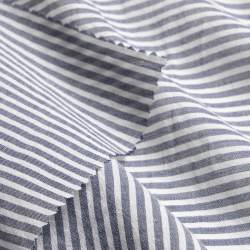


 only limited stock available !





 sold out